第十四章 文件系统 最后的挑战(中)

本文最后更新于:1 年前

第十四章 文件系统 最后的挑战(中)

写在前面

没什么可说的了,现在只想快点结束os这一篇章。。

文件的打开与关闭

fs/file.c修改

1
2
3
4
5
6
7
8
9
10
11
12
13
14
15
16
17
18
19
20
21
22
23
24
25
26
27
28
29
30
31
32
33
34
35
36
37
38
39
40
41
42
43
44
45
46
47
48
49
50
51
52
53
54
55
56
57
58
59
60
61
62
63
64
65
66
67
68
69
70
71
72
73
74
75
76
77
78
79
80
81
82
83
84
85
86
87
88
89
90
91
92
93
94
95
96
97
98
99
100
101
102
103
104
105
106
107
108
109
110
111
112
113
114
115
116
117
118
119
120
121
122
123
124
125
126
127
128
129
130
131
132
133
134
135
136
137
138
139
140
141
142
143
144
145
146
147
148
149
150
151
152
153
154
155
156
157
158
159
160
161
162
163
164
165
166
167
168
169
170
171
172
173
174
175
176
177
178
179
180
181
182
183
184
185
186
187
188
189
190
191
192
193
194
195
196
197
198
199
200
201
202
203
204
205
206
207
208
209
210
211
212
213
214
215
216
217
218
219
220
221
222
223
224
225
226
227
228
229
230
231
232
233
234
235
236
237
238
239
240
241
242
243
244
245
246
247
248
249
250
251
252
253
254
255
256
257
258
259
260
261
262
263
264
265
266
267
268
269
270
271
272
273
274
275
276
277
278
279
280
281
282
283
284
285
286
287
288
289
290
291
292
293
294
295
296
297
298
299
300
301
302
303
304
305
306
307
308
309
310
311
312
313
314
315
316
317
318
319
320
321
322
323
324
325
326
327
328
329
330
331
332
333
334
335
336
337
338
339
340
341
342
343
344
345
346
347
348
349
350
351
352
353
354
355
356
357
358
359
360
361
362
363
364
365
366
367
368
369
370
371
372
373
374
375
376
377
378
379
380
381
382
383
384
385
386
387
388
389
390
391
392
393
394
395
396
397
398
399
400
401
402
403
404
405
406
407
408
409
410
411
412
413
414
415
416
417
418
419
420
421
422
423
424
425
426
427
428
429
430
431
432
433
434
435
436
437
438
439
440
441
442
443
444
#include "fs.h"
#include "stdint.h"
#include "global.h"
#include "../device/ide.h"
#include "inode.h"
#include "dir.h"
#include "super_block.h"
#include "stdio-kernel.h"
#include "string.h"
#include "debug.h"
#include "list.h"
#include "file.h"

struct partition* cur_part; //默认操作分区

static void partition_format(struct partition* part) {
/* 为方便实现,一个块大小是一扇区 */
uint32_t boot_sector_sects = 1;
uint32_t super_block_sects = 1;
uint32_t inode_bitmap_sects = DIV_ROUND_UP(MAX_FILES_PER_PART, BITS_PER_SECTOR); // I结点位图占用的扇区数.最多支持4096个文件
uint32_t inode_table_sects = DIV_ROUND_UP(((sizeof(struct inode) * MAX_FILES_PER_PART)), SECTOR_SIZE);
uint32_t used_sects = boot_sector_sects + super_block_sects + inode_bitmap_sects + inode_table_sects;
uint32_t free_sects = part->sec_cnt - used_sects;

/************** 简单处理块位图占据的扇区数 ***************/
uint32_t block_bitmap_sects;
block_bitmap_sects = DIV_ROUND_UP(free_sects, BITS_PER_SECTOR);
/* block_bitmap_bit_len是位图中位的长度,也是可用块的数量 */
uint32_t block_bitmap_bit_len = free_sects - block_bitmap_sects;
block_bitmap_sects = DIV_ROUND_UP(block_bitmap_bit_len, BITS_PER_SECTOR);
/*********************************************************/

/* 超级块初始化 */
struct super_block sb;
sb.magic = 0x19590318;
sb.sec_cnt = part->sec_cnt;
sb.inode_cnt = MAX_FILES_PER_PART;
sb.part_lba_base = part->start_lba;

sb.block_bitmap_lba = sb.part_lba_base + 2; // 第0块是引导块,第1块是超级块
sb.block_bitmap_sects = block_bitmap_sects;

sb.inode_bitmap_lba = sb.block_bitmap_lba + sb.block_bitmap_sects;
sb.inode_bitmap_sects = inode_bitmap_sects;

sb.inode_table_lba = sb.inode_bitmap_lba + sb.inode_bitmap_sects;
sb.inode_table_sects = inode_table_sects;

sb.data_start_lba = sb.inode_table_lba + sb.inode_table_sects;
sb.root_inode_no = 0;
sb.dir_entry_size = sizeof(struct dir_entry);

printk("%s info:\n", part->name);
printk(" magic:0x%x\n part_lba_base:0x%x\n all_sectors:0x%x\n inode_cnt:0x%x\n block_bitmap_lba:0x%x\n block_bitmap_sectors:0x%x\n inode_bitmap_lba:0x%x\n inode_bitmap_sectors:0x%x\n inode_table_lba:0x%x\n inode_table_sectors:0x%x\n data_start_lba:0x%x\n", sb.magic, sb.part_lba_base, sb.sec_cnt, sb.inode_cnt, sb.block_bitmap_lba, sb.block_bitmap_sects, sb.inode_bitmap_lba, sb.inode_bitmap_sects, sb.inode_table_lba, sb.inode_table_sects, sb.data_start_lba);

struct disk* hd = part->my_disk;
/*******************************
* 1 将超级块写入本分区的1扇区 *
******************************/
ide_write(hd, part->start_lba + 1, &sb, 1);
printk(" super_block_lba:0x%x\n", part->start_lba + 1);

/* 找出数据量最大的元信息,用其尺寸做存储缓冲区*/
uint32_t buf_size = (sb.block_bitmap_sects >= sb.inode_bitmap_sects ? sb.block_bitmap_sects : sb.inode_bitmap_sects);
buf_size = (buf_size >= sb.inode_table_sects ? buf_size : sb.inode_table_sects) * SECTOR_SIZE;
uint8_t* buf = (uint8_t*)sys_malloc(buf_size); // 申请的内存由内存管理系统清0后返回

/**************************************
* 2 将块位图初始化并写入sb.block_bitmap_lba *
*************************************/
/* 初始化块位图block_bitmap */
buf[0] |= 0x01; // 第0个块预留给根目录,位图中先占位
uint32_t block_bitmap_last_byte = block_bitmap_bit_len / 8;
uint8_t block_bitmap_last_bit = block_bitmap_bit_len % 8;
uint32_t last_size = SECTOR_SIZE - (block_bitmap_last_byte % SECTOR_SIZE); // last_size是位图所在最后一个扇区中,不足一扇区的其余部分

/* 1 先将位图最后一字节到其所在的扇区的结束全置为1,即超出实际块数的部分直接置为已占用*/
memset(&buf[block_bitmap_last_byte], 0xff, last_size);

/* 2 再将上一步中覆盖的最后一字节内的有效位重新置0 */
uint8_t bit_idx = 0;
while (bit_idx <= block_bitmap_last_bit) {
buf[block_bitmap_last_byte] &= ~(1 << bit_idx++);
}
ide_write(hd, sb.block_bitmap_lba, buf, sb.block_bitmap_sects);

/***************************************
* 3 将inode位图初始化并写入sb.inode_bitmap_lba *
***************************************/
/* 先清空缓冲区*/
memset(buf, 0, buf_size);
buf[0] |= 0x1; // 第0个inode分给了根目录
/* 由于inode_table中共4096个inode,位图inode_bitmap正好占用1扇区,
* 即inode_bitmap_sects等于1, 所以位图中的位全都代表inode_table中的inode,
* 无须再像block_bitmap那样单独处理最后一扇区的剩余部分,
* inode_bitmap所在的扇区中没有多余的无效位 */
ide_write(hd, sb.inode_bitmap_lba, buf, sb.inode_bitmap_sects);

/***************************************
* 4 将inode数组初始化并写入sb.inode_table_lba *
***************************************/
/* 准备写inode_table中的第0项,即根目录所在的inode */
memset(buf, 0, buf_size); // 先清空缓冲区buf
struct inode* i = (struct inode*)buf;
i->i_size = sb.dir_entry_size * 2; // .和..
i->i_no = 0; // 根目录占inode数组中第0个inode
i->i_sectors[0] = sb.data_start_lba; // 由于上面的memset,i_sectors数组的其它元素都初始化为0
ide_write(hd, sb.inode_table_lba, buf, sb.inode_table_sects);

/***************************************
* 5 将根目录初始化并写入sb.data_start_lba
***************************************/
/* 写入根目录的两个目录项.和.. */
memset(buf, 0, buf_size);
struct dir_entry* p_de = (struct dir_entry*)buf;

/* 初始化当前目录"." */
memcpy(p_de->filename, ".", 1);
p_de->i_no = 0;
p_de->f_type = FT_DIRECTORY;
p_de++;

/* 初始化当前目录父目录".." */
memcpy(p_de->filename, "..", 2);
p_de->i_no = 0; // 根目录的父目录依然是根目录自己
p_de->f_type = FT_DIRECTORY;

/* sb.data_start_lba已经分配给了根目录,里面是根目录的目录项 */
ide_write(hd, sb.data_start_lba, buf, 1);

printk(" root_dir_lba:0x%x\n", sb.data_start_lba);
printk("%s format done\n", part->name);
sys_free(buf);
}

//除了挂载 还需要在内存中把超级块指针 块位图 i结点位图 i结点指针给初始化赋值了 方便使用
static bool mount_partition(struct list_elem* pelem, int arg) {
char* part_name = (char*)arg;
struct partition* part = elem2entry(struct partition, part_tag, pelem);
if (!strcmp(part->name, part_name)) {
cur_part = part;
struct disk* hd = cur_part->my_disk;

/* sb_buf用来存储从硬盘上读入的超级块 */
struct super_block* sb_buf = (struct super_block*)sys_malloc(SECTOR_SIZE);

/* 在内存中创建分区cur_part的超级块 */
cur_part->sb = (struct super_block*)sys_malloc(sizeof(struct super_block));
if (cur_part->sb == NULL) {
PANIC("alloc memory failed!");
}

/* 读入超级块 */
memset(sb_buf, 0, SECTOR_SIZE);
ide_read(hd, cur_part->start_lba + 1, sb_buf, 1);

/* 把sb_buf中超级块的信息复制到分区的超级块sb中。*/
memcpy(cur_part->sb, sb_buf, sizeof(struct super_block));

/********** 将硬盘上的块位图读入到内存 ****************/
cur_part->block_bitmap.bits = (uint8_t*)sys_malloc(sb_buf->block_bitmap_sects * SECTOR_SIZE);
if (cur_part->block_bitmap.bits == NULL) {
PANIC("alloc memory failed!");
}
cur_part->block_bitmap.btmp_bytes_len = sb_buf->block_bitmap_sects * SECTOR_SIZE;
/* 从硬盘上读入块位图到分区的block_bitmap.bits */
ide_read(hd, sb_buf->block_bitmap_lba, cur_part->block_bitmap.bits, sb_buf->block_bitmap_sects);
/*************************************************************/

/********** 将硬盘上的inode位图读入到内存 ************/
cur_part->inode_bitmap.bits = (uint8_t*)sys_malloc(sb_buf->inode_bitmap_sects * SECTOR_SIZE);
if (cur_part->inode_bitmap.bits == NULL) {
PANIC("alloc memory failed!");
}
cur_part->inode_bitmap.btmp_bytes_len = sb_buf->inode_bitmap_sects * SECTOR_SIZE;
/* 从硬盘上读入inode位图到分区的inode_bitmap.bits */
ide_read(hd, sb_buf->inode_bitmap_lba, cur_part->inode_bitmap.bits, sb_buf->inode_bitmap_sects);
/*************************************************************/

list_init(&cur_part->open_inodes);
printk("mount %s done!\n", part->name);

/* 此处返回true是为了迎合主调函数list_traversal的实现,与函数本身功能无关。
只有返回true时list_traversal才会停止遍历,减少了后面元素无意义的遍历.*/
return true;
}
return false; // 使list_traversal继续遍历
}

//文件系统初始化 磁盘上搜索 如果没有则格式化分区 并创建文件系统
/* 在磁盘上搜索文件系统,若没有则格式化分区创建文件系统 */
void filesys_init() {
uint8_t channel_no = 0, dev_no, part_idx = 0;

/* sb_buf用来存储从硬盘上读入的超级块 */
struct super_block* sb_buf = (struct super_block*)sys_malloc(SECTOR_SIZE);

if (sb_buf == NULL) {
PANIC("alloc memory failed!");
}
printk("searching filesystem......\n");
while (channel_no < channel_cnt) {
dev_no = 0;
while(dev_no < 2) {
if (dev_no == 0) { // 跨过裸盘hd60M.img
dev_no++;
continue;
}
struct disk* hd = &channels[channel_no].devices[dev_no];
struct partition* part = hd->prim_parts;
while(part_idx < 12) { // 4个主分区+8个逻辑
if (part_idx == 4) { // 开始处理逻辑分区
part = hd->logic_parts;
}

/* channels数组是全局变量,默认值为0,disk属于其嵌套结构,
* partition又为disk的嵌套结构,因此partition中的成员默认也为0.
* 若partition未初始化,则partition中的成员仍为0.
* 下面处理存在的分区. */
if (part->sec_cnt != 0) { // 如果分区存在
memset(sb_buf, 0, SECTOR_SIZE);

/* 读出分区的超级块,根据魔数是否正确来判断是否存在文件系统 */
ide_read(hd, part->start_lba + 1, sb_buf, 1);

/* 只支持自己的文件系统.若磁盘上已经有文件系统就不再格式化了 */
if (sb_buf->magic == 0x19590318) {
printk("%s has filesystem\n", part->name);
} else { // 其它文件系统不支持,一律按无文件系统处理
printk("formatting %s`s partition %s......\n", hd->name, part->name);
partition_format(part);
}
}
part_idx++;
part++; // 下一分区
}
dev_no++; // 下一磁盘
}
channel_no++; // 下一通道
}
sys_free(sb_buf);
/* 确定默认操作的分区 */
char default_part[8] = "sdb1";
/* 挂载分区 */
list_traversal(&partition_list, mount_partition, (int)default_part);
/* 将当前分区的根目录打开 */
open_root_dir(cur_part);

/* 初始化文件表 */
uint32_t fd_idx = 0;
while (fd_idx < MAX_FILE_OPEN) {
file_table[fd_idx++].fd_inode = NULL;
}
}

/* 将最上层路径名称解析出来 */
char* path_parse(char* pathname, char* name_store) {
if (pathname[0] == '/') { // 根目录不需要单独解析
/* 路径中出现1个或多个连续的字符'/',将这些'/'跳过,如"///a/b" */
while(*(++pathname) == '/');
}

/* 开始一般的路径解析 */
while (*pathname != '/' && *pathname != 0) {
*name_store++ = *pathname++;
}

if (pathname[0] == 0) { // 若路径字符串为空则返回NULL
return NULL;
}
return pathname;
}

/* 返回路径深度,比如/a/b/c,深度为3 */
int32_t path_depth_cnt(char* pathname) {
ASSERT(pathname != NULL);
char* p = pathname;
char name[MAX_FILE_NAME_LEN]; // 用于path_parse的参数做路径解析
uint32_t depth = 0;

/* 解析路径,从中拆分出各级名称 */
p = path_parse(p, name);
while (name[0]) {
depth++;
memset(name, 0, MAX_FILE_NAME_LEN);
if (p) { // 如果p不等于NULL,继续分析路径
p = path_parse(p, name);
}
}
return depth;
}

/* 搜索文件pathname,若找到则返回其inode号,否则返回-1 */
static int search_file(const char* pathname, struct path_search_record* searched_record) {
/* 如果待查找的是根目录,为避免下面无用的查找,直接返回已知根目录信息 */
if (!strcmp(pathname, "/") || !strcmp(pathname, "/.") || !strcmp(pathname, "/..")) {
searched_record->parent_dir = &root_dir;
searched_record->file_type = FT_DIRECTORY;
searched_record->searched_path[0] = 0; // 搜索路径置空
return 0;
}

uint32_t path_len = strlen(pathname);
/* 保证pathname至少是这样的路径/x且小于最大长度 */
ASSERT(pathname[0] == '/' && path_len > 1 && path_len < MAX_PATH_LEN);
char* sub_path = (char*)pathname;
struct dir* parent_dir = &root_dir;
struct dir_entry dir_e;

/* 记录路径解析出来的各级名称,如路径"/a/b/c",
* 数组name每次的值分别是"a","b","c" */
char name[MAX_FILE_NAME_LEN] = {0};

searched_record->parent_dir = parent_dir;
searched_record->file_type = FT_UNKNOWN;
uint32_t parent_inode_no = 0; // 父目录的inode号

sub_path = path_parse(sub_path, name);
while (name[0]) { // 若第一个字符就是结束符,结束循环
/* 记录查找过的路径,但不能超过searched_path的长度512字节 */
ASSERT(strlen(searched_record->searched_path) < 512);

/* 记录已存在的父目录 */
strcat(searched_record->searched_path, "/");
strcat(searched_record->searched_path, name);

/* 在所给的目录中查找文件 */
if (search_dir_entry(cur_part, parent_dir, name, &dir_e)) {
memset(name, 0, MAX_FILE_NAME_LEN);
/* 若sub_path不等于NULL,也就是未结束时继续拆分路径 */
if (sub_path) {
sub_path = path_parse(sub_path, name);
}

if (FT_DIRECTORY == dir_e.f_type) { // 如果被打开的是目录
parent_inode_no = parent_dir->inode->i_no;
dir_close(parent_dir);
parent_dir = dir_open(cur_part, dir_e.i_no); // 更新父目录
searched_record->parent_dir = parent_dir;
continue;
} else if (FT_REGULAR == dir_e.f_type) { // 若是普通文件
searched_record->file_type = FT_REGULAR;
return dir_e.i_no;
}
} else { //若找不到,则返回-1
/* 找不到目录项时,要留着parent_dir不要关闭,
* 若是创建新文件的话需要在parent_dir中创建 */
return -1;
}
}

/* 执行到此,必然是遍历了完整路径并且查找的文件或目录只有同名目录存在 */
dir_close(searched_record->parent_dir);

/* 保存被查找目录的直接父目录 */
searched_record->parent_dir = dir_open(cur_part, parent_inode_no);
searched_record->file_type = FT_DIRECTORY;
return dir_e.i_no;
}

/* 打开或创建文件成功后,返回文件描述符,否则返回-1 */
int32_t sys_open(const char* pathname, uint8_t flags) {
/* 对目录要用dir_open,这里只有open文件 */
if (pathname[strlen(pathname) - 1] == '/') {
printk("can`t open a directory %s\n",pathname);
return -1;
}
ASSERT(flags <= 7);
int32_t fd = -1; // 默认为找不到

struct path_search_record searched_record;
memset(&searched_record, 0, sizeof(struct path_search_record));

/* 记录目录深度.帮助判断中间某个目录不存在的情况 */
uint32_t pathname_depth = path_depth_cnt((char*)pathname);

/* 先检查文件是否存在 */
int inode_no = search_file(pathname, &searched_record);
bool found = inode_no != -1 ? true : false;

if (searched_record.file_type == FT_DIRECTORY) {
printk("can`t open a direcotry with open(), use opendir() to instead\n");
dir_close(searched_record.parent_dir);
return -1;
}

uint32_t path_searched_depth = path_depth_cnt(searched_record.searched_path);

/* 先判断是否把pathname的各层目录都访问到了,即是否在某个中间目录就失败了 */
if (pathname_depth != path_searched_depth) { // 说明并没有访问到全部的路径,某个中间目录是不存在的
printk("cannot access %s: Not a directory, subpath %s is`t exist\n", \
pathname, searched_record.searched_path);
dir_close(searched_record.parent_dir);
return -1;
}

/* 若是在最后一个路径上没找到,并且并不是要创建文件,直接返回-1 */
if (!found && !(flags & O_CREAT)) {
printk("in path %s, file %s is`t exist\n", \
searched_record.searched_path, \
(strrchr(searched_record.searched_path, '/') + 1));
dir_close(searched_record.parent_dir);
return -1;
} else if (found && flags & O_CREAT) { // 若要创建的文件已存在
printk("%s has already exist!\n", pathname);
dir_close(searched_record.parent_dir);
return -1;
}

switch (flags & O_CREAT) {
case O_CREAT:
printk("creating file\n");
fd = file_create(searched_record.parent_dir, (strrchr(pathname, '/') + 1), flags);
dir_close(searched_record.parent_dir);
break;
default:
/* 其余情况均为打开已存在文件:
* O_RDONLY,O_WRONLY,O_RDWR */
fd = file_open(inode_no, flags);
}

/* 此fd是指任务pcb->fd_table数组中的元素下标,
* 并不是指全局file_table中的下标 */
return fd;
}

/* 将文件描述符转化为文件表的下标 */
uint32_t fd_local2global(uint32_t local_fd) {
struct task_struct* cur = running_thread();
int32_t global_fd = cur->fd_table[local_fd];
ASSERT(global_fd >= 0 && global_fd < MAX_FILE_OPEN);
return (uint32_t)global_fd;
}

/* 关闭文件描述符fd指向的文件,成功返回0,否则返回-1 */
int32_t sys_close(int32_t fd) {
int32_t ret = -1; // 返回值默认为-1,即失败
if (fd > 2) {
uint32_t global_fd = fd_local2global(fd);
ret = file_close(&file_table[global_fd]);
running_thread()->fd_table[fd] = -1; // 使该文件描述符位可用
}
return ret;
}

fs/fs.c修改

1
2
3
4
5
6
7
8
9
10
11
12
13
14
15
16
17
18
19
20
21
22
23
24
25
26
27
28
29
30
31
32
33
34
35
36
37
38
39
40
41
42
43
44
45
46
47
48
49
50
51
52
53
54
55
56
57
58
59
60
61
62
63
64
65
66
67
68
69
70
71
72
73
74
75
76
77
78
79
80
81
82
83
84
85
86
87
88
89
90
91
92
93
94
95
96
97
98
99
100
101
102
103
104
105
106
107
108
109
110
111
112
113
114
115
116
117
118
119
120
121
122
123
124
125
126
127
128
129
130
131
132
133
134
135
136
137
138
139
140
141
142
143
144
145
146
147
148
149
150
151
152
153
154
155
156
157
158
159
160
161
162
163
164
165
166
167
168
169
170
171
172
173
174
175
176
177
178
179
180
181
182
183
184
185
186
187
188
189
190
191
192
193
194
195
196
197
198
199
200
201
202
203
204
205
206
207
208
209
210
211
212
213
214
215
216
217
218
219
220
221
222
223
224
225
226
227
228
229
230
231
232
233
234
235
236
237
238
239
240
241
242
243
244
245
246
247
248
249
250
251
252
253
254
255
256
257
258
259
260
261
262
263
264
265
266
267
268
269
270
271
272
273
274
275
276
277
278
279
280
281
282
283
284
285
286
287
288
289
290
291
292
293
294
295
296
297
298
299
300
301
302
303
304
305
306
307
308
309
310
311
312
313
314
315
316
317
318
319
320
321
322
323
324
325
326
327
328
329
330
331
332
333
334
335
336
337
338
339
340
341
342
343
344
345
346
347
348
349
350
351
352
353
354
355
356
357
358
359
360
361
362
363
364
365
366
367
368
369
370
371
372
373
374
375
376
377
378
379
380
381
382
383
384
385
386
387
388
389
390
391
392
393
394
395
396
397
398
399
400
401
402
403
404
405
406
407
408
409
410
411
412
413
414
415
416
417
418
419
420
421
422
423
424
425
426
427
428
429
430
431
432
433
434
435
436
437
438
439
440
441
442
443
444
#include "fs.h"
#include "stdint.h"
#include "global.h"
#include "../device/ide.h"
#include "inode.h"
#include "dir.h"
#include "super_block.h"
#include "stdio-kernel.h"
#include "string.h"
#include "debug.h"
#include "list.h"
#include "file.h"

struct partition* cur_part; //默认操作分区

static void partition_format(struct partition* part) {
/* 为方便实现,一个块大小是一扇区 */
uint32_t boot_sector_sects = 1;
uint32_t super_block_sects = 1;
uint32_t inode_bitmap_sects = DIV_ROUND_UP(MAX_FILES_PER_PART, BITS_PER_SECTOR); // I结点位图占用的扇区数.最多支持4096个文件
uint32_t inode_table_sects = DIV_ROUND_UP(((sizeof(struct inode) * MAX_FILES_PER_PART)), SECTOR_SIZE);
uint32_t used_sects = boot_sector_sects + super_block_sects + inode_bitmap_sects + inode_table_sects;
uint32_t free_sects = part->sec_cnt - used_sects;

/************** 简单处理块位图占据的扇区数 ***************/
uint32_t block_bitmap_sects;
block_bitmap_sects = DIV_ROUND_UP(free_sects, BITS_PER_SECTOR);
/* block_bitmap_bit_len是位图中位的长度,也是可用块的数量 */
uint32_t block_bitmap_bit_len = free_sects - block_bitmap_sects;
block_bitmap_sects = DIV_ROUND_UP(block_bitmap_bit_len, BITS_PER_SECTOR);
/*********************************************************/

/* 超级块初始化 */
struct super_block sb;
sb.magic = 0x19590318;
sb.sec_cnt = part->sec_cnt;
sb.inode_cnt = MAX_FILES_PER_PART;
sb.part_lba_base = part->start_lba;

sb.block_bitmap_lba = sb.part_lba_base + 2; // 第0块是引导块,第1块是超级块
sb.block_bitmap_sects = block_bitmap_sects;

sb.inode_bitmap_lba = sb.block_bitmap_lba + sb.block_bitmap_sects;
sb.inode_bitmap_sects = inode_bitmap_sects;

sb.inode_table_lba = sb.inode_bitmap_lba + sb.inode_bitmap_sects;
sb.inode_table_sects = inode_table_sects;

sb.data_start_lba = sb.inode_table_lba + sb.inode_table_sects;
sb.root_inode_no = 0;
sb.dir_entry_size = sizeof(struct dir_entry);

printk("%s info:\n", part->name);
printk(" magic:0x%x\n part_lba_base:0x%x\n all_sectors:0x%x\n inode_cnt:0x%x\n block_bitmap_lba:0x%x\n block_bitmap_sectors:0x%x\n inode_bitmap_lba:0x%x\n inode_bitmap_sectors:0x%x\n inode_table_lba:0x%x\n inode_table_sectors:0x%x\n data_start_lba:0x%x\n", sb.magic, sb.part_lba_base, sb.sec_cnt, sb.inode_cnt, sb.block_bitmap_lba, sb.block_bitmap_sects, sb.inode_bitmap_lba, sb.inode_bitmap_sects, sb.inode_table_lba, sb.inode_table_sects, sb.data_start_lba);

struct disk* hd = part->my_disk;
/*******************************
* 1 将超级块写入本分区的1扇区 *
******************************/
ide_write(hd, part->start_lba + 1, &sb, 1);
printk(" super_block_lba:0x%x\n", part->start_lba + 1);

/* 找出数据量最大的元信息,用其尺寸做存储缓冲区*/
uint32_t buf_size = (sb.block_bitmap_sects >= sb.inode_bitmap_sects ? sb.block_bitmap_sects : sb.inode_bitmap_sects);
buf_size = (buf_size >= sb.inode_table_sects ? buf_size : sb.inode_table_sects) * SECTOR_SIZE;
uint8_t* buf = (uint8_t*)sys_malloc(buf_size); // 申请的内存由内存管理系统清0后返回

/**************************************
* 2 将块位图初始化并写入sb.block_bitmap_lba *
*************************************/
/* 初始化块位图block_bitmap */
buf[0] |= 0x01; // 第0个块预留给根目录,位图中先占位
uint32_t block_bitmap_last_byte = block_bitmap_bit_len / 8;
uint8_t block_bitmap_last_bit = block_bitmap_bit_len % 8;
uint32_t last_size = SECTOR_SIZE - (block_bitmap_last_byte % SECTOR_SIZE); // last_size是位图所在最后一个扇区中,不足一扇区的其余部分

/* 1 先将位图最后一字节到其所在的扇区的结束全置为1,即超出实际块数的部分直接置为已占用*/
memset(&buf[block_bitmap_last_byte], 0xff, last_size);

/* 2 再将上一步中覆盖的最后一字节内的有效位重新置0 */
uint8_t bit_idx = 0;
while (bit_idx <= block_bitmap_last_bit) {
buf[block_bitmap_last_byte] &= ~(1 << bit_idx++);
}
ide_write(hd, sb.block_bitmap_lba, buf, sb.block_bitmap_sects);

/***************************************
* 3 将inode位图初始化并写入sb.inode_bitmap_lba *
***************************************/
/* 先清空缓冲区*/
memset(buf, 0, buf_size);
buf[0] |= 0x1; // 第0个inode分给了根目录
/* 由于inode_table中共4096个inode,位图inode_bitmap正好占用1扇区,
* 即inode_bitmap_sects等于1, 所以位图中的位全都代表inode_table中的inode,
* 无须再像block_bitmap那样单独处理最后一扇区的剩余部分,
* inode_bitmap所在的扇区中没有多余的无效位 */
ide_write(hd, sb.inode_bitmap_lba, buf, sb.inode_bitmap_sects);

/***************************************
* 4 将inode数组初始化并写入sb.inode_table_lba *
***************************************/
/* 准备写inode_table中的第0项,即根目录所在的inode */
memset(buf, 0, buf_size); // 先清空缓冲区buf
struct inode* i = (struct inode*)buf;
i->i_size = sb.dir_entry_size * 2; // .和..
i->i_no = 0; // 根目录占inode数组中第0个inode
i->i_sectors[0] = sb.data_start_lba; // 由于上面的memset,i_sectors数组的其它元素都初始化为0
ide_write(hd, sb.inode_table_lba, buf, sb.inode_table_sects);

/***************************************
* 5 将根目录初始化并写入sb.data_start_lba
***************************************/
/* 写入根目录的两个目录项.和.. */
memset(buf, 0, buf_size);
struct dir_entry* p_de = (struct dir_entry*)buf;

/* 初始化当前目录"." */
memcpy(p_de->filename, ".", 1);
p_de->i_no = 0;
p_de->f_type = FT_DIRECTORY;
p_de++;

/* 初始化当前目录父目录".." */
memcpy(p_de->filename, "..", 2);
p_de->i_no = 0; // 根目录的父目录依然是根目录自己
p_de->f_type = FT_DIRECTORY;

/* sb.data_start_lba已经分配给了根目录,里面是根目录的目录项 */
ide_write(hd, sb.data_start_lba, buf, 1);

printk(" root_dir_lba:0x%x\n", sb.data_start_lba);
printk("%s format done\n", part->name);
sys_free(buf);
}

//除了挂载 还需要在内存中把超级块指针 块位图 i结点位图 i结点指针给初始化赋值了 方便使用
static bool mount_partition(struct list_elem* pelem, int arg) {
char* part_name = (char*)arg;
struct partition* part = elem2entry(struct partition, part_tag, pelem);
if (!strcmp(part->name, part_name)) {
cur_part = part;
struct disk* hd = cur_part->my_disk;

/* sb_buf用来存储从硬盘上读入的超级块 */
struct super_block* sb_buf = (struct super_block*)sys_malloc(SECTOR_SIZE);

/* 在内存中创建分区cur_part的超级块 */
cur_part->sb = (struct super_block*)sys_malloc(sizeof(struct super_block));
if (cur_part->sb == NULL) {
PANIC("alloc memory failed!");
}

/* 读入超级块 */
memset(sb_buf, 0, SECTOR_SIZE);
ide_read(hd, cur_part->start_lba + 1, sb_buf, 1);

/* 把sb_buf中超级块的信息复制到分区的超级块sb中。*/
memcpy(cur_part->sb, sb_buf, sizeof(struct super_block));

/********** 将硬盘上的块位图读入到内存 ****************/
cur_part->block_bitmap.bits = (uint8_t*)sys_malloc(sb_buf->block_bitmap_sects * SECTOR_SIZE);
if (cur_part->block_bitmap.bits == NULL) {
PANIC("alloc memory failed!");
}
cur_part->block_bitmap.btmp_bytes_len = sb_buf->block_bitmap_sects * SECTOR_SIZE;
/* 从硬盘上读入块位图到分区的block_bitmap.bits */
ide_read(hd, sb_buf->block_bitmap_lba, cur_part->block_bitmap.bits, sb_buf->block_bitmap_sects);
/*************************************************************/

/********** 将硬盘上的inode位图读入到内存 ************/
cur_part->inode_bitmap.bits = (uint8_t*)sys_malloc(sb_buf->inode_bitmap_sects * SECTOR_SIZE);
if (cur_part->inode_bitmap.bits == NULL) {
PANIC("alloc memory failed!");
}
cur_part->inode_bitmap.btmp_bytes_len = sb_buf->inode_bitmap_sects * SECTOR_SIZE;
/* 从硬盘上读入inode位图到分区的inode_bitmap.bits */
ide_read(hd, sb_buf->inode_bitmap_lba, cur_part->inode_bitmap.bits, sb_buf->inode_bitmap_sects);
/*************************************************************/

list_init(&cur_part->open_inodes);
printk("mount %s done!\n", part->name);

/* 此处返回true是为了迎合主调函数list_traversal的实现,与函数本身功能无关。
只有返回true时list_traversal才会停止遍历,减少了后面元素无意义的遍历.*/
return true;
}
return false; // 使list_traversal继续遍历
}

//文件系统初始化 磁盘上搜索 如果没有则格式化分区 并创建文件系统
/* 在磁盘上搜索文件系统,若没有则格式化分区创建文件系统 */
void filesys_init() {
uint8_t channel_no = 0, dev_no, part_idx = 0;

/* sb_buf用来存储从硬盘上读入的超级块 */
struct super_block* sb_buf = (struct super_block*)sys_malloc(SECTOR_SIZE);

if (sb_buf == NULL) {
PANIC("alloc memory failed!");
}
printk("searching filesystem......\n");
while (channel_no < channel_cnt) {
dev_no = 0;
while(dev_no < 2) {
if (dev_no == 0) { // 跨过裸盘hd60M.img
dev_no++;
continue;
}
struct disk* hd = &channels[channel_no].devices[dev_no];
struct partition* part = hd->prim_parts;
while(part_idx < 12) { // 4个主分区+8个逻辑
if (part_idx == 4) { // 开始处理逻辑分区
part = hd->logic_parts;
}

/* channels数组是全局变量,默认值为0,disk属于其嵌套结构,
* partition又为disk的嵌套结构,因此partition中的成员默认也为0.
* 若partition未初始化,则partition中的成员仍为0.
* 下面处理存在的分区. */
if (part->sec_cnt != 0) { // 如果分区存在
memset(sb_buf, 0, SECTOR_SIZE);

/* 读出分区的超级块,根据魔数是否正确来判断是否存在文件系统 */
ide_read(hd, part->start_lba + 1, sb_buf, 1);

/* 只支持自己的文件系统.若磁盘上已经有文件系统就不再格式化了 */
if (sb_buf->magic == 0x19590318) {
printk("%s has filesystem\n", part->name);
} else { // 其它文件系统不支持,一律按无文件系统处理
printk("formatting %s`s partition %s......\n", hd->name, part->name);
partition_format(part);
}
}
part_idx++;
part++; // 下一分区
}
dev_no++; // 下一磁盘
}
channel_no++; // 下一通道
}
sys_free(sb_buf);
/* 确定默认操作的分区 */
char default_part[8] = "sdb1";
/* 挂载分区 */
list_traversal(&partition_list, mount_partition, (int)default_part);
/* 将当前分区的根目录打开 */
open_root_dir(cur_part);

/* 初始化文件表 */
uint32_t fd_idx = 0;
while (fd_idx < MAX_FILE_OPEN) {
file_table[fd_idx++].fd_inode = NULL;
}
}

/* 将最上层路径名称解析出来 */
char* path_parse(char* pathname, char* name_store) {
if (pathname[0] == '/') { // 根目录不需要单独解析
/* 路径中出现1个或多个连续的字符'/',将这些'/'跳过,如"///a/b" */
while(*(++pathname) == '/');
}

/* 开始一般的路径解析 */
while (*pathname != '/' && *pathname != 0) {
*name_store++ = *pathname++;
}

if (pathname[0] == 0) { // 若路径字符串为空则返回NULL
return NULL;
}
return pathname;
}

/* 返回路径深度,比如/a/b/c,深度为3 */
int32_t path_depth_cnt(char* pathname) {
ASSERT(pathname != NULL);
char* p = pathname;
char name[MAX_FILE_NAME_LEN]; // 用于path_parse的参数做路径解析
uint32_t depth = 0;

/* 解析路径,从中拆分出各级名称 */
p = path_parse(p, name);
while (name[0]) {
depth++;
memset(name, 0, MAX_FILE_NAME_LEN);
if (p) { // 如果p不等于NULL,继续分析路径
p = path_parse(p, name);
}
}
return depth;
}

/* 搜索文件pathname,若找到则返回其inode号,否则返回-1 */
static int search_file(const char* pathname, struct path_search_record* searched_record) {
/* 如果待查找的是根目录,为避免下面无用的查找,直接返回已知根目录信息 */
if (!strcmp(pathname, "/") || !strcmp(pathname, "/.") || !strcmp(pathname, "/..")) {
searched_record->parent_dir = &root_dir;
searched_record->file_type = FT_DIRECTORY;
searched_record->searched_path[0] = 0; // 搜索路径置空
return 0;
}

uint32_t path_len = strlen(pathname);
/* 保证pathname至少是这样的路径/x且小于最大长度 */
ASSERT(pathname[0] == '/' && path_len > 1 && path_len < MAX_PATH_LEN);
char* sub_path = (char*)pathname;
struct dir* parent_dir = &root_dir;
struct dir_entry dir_e;

/* 记录路径解析出来的各级名称,如路径"/a/b/c",
* 数组name每次的值分别是"a","b","c" */
char name[MAX_FILE_NAME_LEN] = {0};

searched_record->parent_dir = parent_dir;
searched_record->file_type = FT_UNKNOWN;
uint32_t parent_inode_no = 0; // 父目录的inode号

sub_path = path_parse(sub_path, name);
while (name[0]) { // 若第一个字符就是结束符,结束循环
/* 记录查找过的路径,但不能超过searched_path的长度512字节 */
ASSERT(strlen(searched_record->searched_path) < 512);

/* 记录已存在的父目录 */
strcat(searched_record->searched_path, "/");
strcat(searched_record->searched_path, name);

/* 在所给的目录中查找文件 */
if (search_dir_entry(cur_part, parent_dir, name, &dir_e)) {
memset(name, 0, MAX_FILE_NAME_LEN);
/* 若sub_path不等于NULL,也就是未结束时继续拆分路径 */
if (sub_path) {
sub_path = path_parse(sub_path, name);
}

if (FT_DIRECTORY == dir_e.f_type) { // 如果被打开的是目录
parent_inode_no = parent_dir->inode->i_no;
dir_close(parent_dir);
parent_dir = dir_open(cur_part, dir_e.i_no); // 更新父目录
searched_record->parent_dir = parent_dir;
continue;
} else if (FT_REGULAR == dir_e.f_type) { // 若是普通文件
searched_record->file_type = FT_REGULAR;
return dir_e.i_no;
}
} else { //若找不到,则返回-1
/* 找不到目录项时,要留着parent_dir不要关闭,
* 若是创建新文件的话需要在parent_dir中创建 */
return -1;
}
}

/* 执行到此,必然是遍历了完整路径并且查找的文件或目录只有同名目录存在 */
dir_close(searched_record->parent_dir);

/* 保存被查找目录的直接父目录 */
searched_record->parent_dir = dir_open(cur_part, parent_inode_no);
searched_record->file_type = FT_DIRECTORY;
return dir_e.i_no;
}

/* 打开或创建文件成功后,返回文件描述符,否则返回-1 */
int32_t sys_open(const char* pathname, uint8_t flags) {
/* 对目录要用dir_open,这里只有open文件 */
if (pathname[strlen(pathname) - 1] == '/') {
printk("can`t open a directory %s\n",pathname);
return -1;
}
ASSERT(flags <= 7);
int32_t fd = -1; // 默认为找不到

struct path_search_record searched_record;
memset(&searched_record, 0, sizeof(struct path_search_record));

/* 记录目录深度.帮助判断中间某个目录不存在的情况 */
uint32_t pathname_depth = path_depth_cnt((char*)pathname);

/* 先检查文件是否存在 */
int inode_no = search_file(pathname, &searched_record);
bool found = inode_no != -1 ? true : false;

if (searched_record.file_type == FT_DIRECTORY) {
printk("can`t open a direcotry with open(), use opendir() to instead\n");
dir_close(searched_record.parent_dir);
return -1;
}

uint32_t path_searched_depth = path_depth_cnt(searched_record.searched_path);

/* 先判断是否把pathname的各层目录都访问到了,即是否在某个中间目录就失败了 */
if (pathname_depth != path_searched_depth) { // 说明并没有访问到全部的路径,某个中间目录是不存在的
printk("cannot access %s: Not a directory, subpath %s is`t exist\n", \
pathname, searched_record.searched_path);
dir_close(searched_record.parent_dir);
return -1;
}

/* 若是在最后一个路径上没找到,并且并不是要创建文件,直接返回-1 */
if (!found && !(flags & O_CREAT)) {
printk("in path %s, file %s is`t exist\n", \
searched_record.searched_path, \
(strrchr(searched_record.searched_path, '/') + 1));
dir_close(searched_record.parent_dir);
return -1;
} else if (found && flags & O_CREAT) { // 若要创建的文件已存在
printk("%s has already exist!\n", pathname);
dir_close(searched_record.parent_dir);
return -1;
}

switch (flags & O_CREAT) {
case O_CREAT:
printk("creating file\n");
fd = file_create(searched_record.parent_dir, (strrchr(pathname, '/') + 1), flags);
dir_close(searched_record.parent_dir);
break;
default:
/* 其余情况均为打开已存在文件:
* O_RDONLY,O_WRONLY,O_RDWR */
fd = file_open(inode_no, flags);
}

/* 此fd是指任务pcb->fd_table数组中的元素下标,
* 并不是指全局file_table中的下标 */
return fd;
}

/* 将文件描述符转化为文件表的下标 */
uint32_t fd_local2global(uint32_t local_fd) {
struct task_struct* cur = running_thread();
int32_t global_fd = cur->fd_table[local_fd];
ASSERT(global_fd >= 0 && global_fd < MAX_FILE_OPEN);
return (uint32_t)global_fd;
}

/* 关闭文件描述符fd指向的文件,成功返回0,否则返回-1 */
int32_t sys_close(int32_t fd) {
int32_t ret = -1; // 返回值默认为-1,即失败
if (fd > 2) {
uint32_t global_fd = fd_local2global(fd);
ret = file_close(&file_table[global_fd]);
running_thread()->fd_table[fd] = -1; // 使该文件描述符位可用
}
return ret;
}

kernel/main.c修改

1
2
3
4
5
6
7
8
9
10
11
12
13
14
15
16
17
18
19
20
21
22
23
24
25
26
27
28
29
30
31
32
#include "print.h"
#include "init.h"
#include "debug.h"
#include "string.h"
#include "memory.h"
#include "../thread/thread.h"
#include "interrupt.h"
#include "../device/console.h"
#include "../device/ioqueue.h"
#include "../device/keyboard.h"
#include "../userprog/process.h"
#include "../lib/user/syscall.h"
#include "../userprog/syscall-init.h"
#include "../lib/stdio.h"
#include "../lib/kernel/stdio-kernel.h"
#include "../fs/fs.h"
#include "../fs/file.h"


int main(void) {
put_str("I am kernel\n");
init_all();

intr_enable();

uint32_t fd = sys_open("/file1",O_RDONLY);
printf("fd:%d\n", fd);
sys_close(fd);
printf("%d closed now\n", fd);
while(1);
return 0;
}

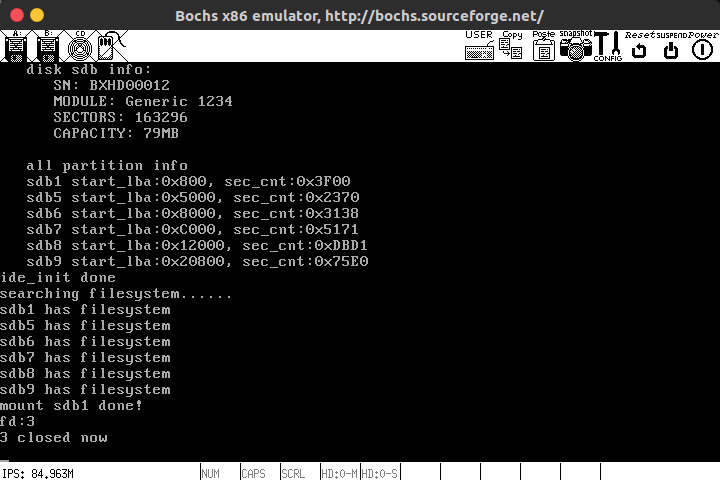
运行结果

图为bochs运行界面

文件的写入

别忘了把文件对应的头文件里的函数定义也修改了噢。

fs/fs.c修改

1
2
3
4
5
6
7
8
9
10
11
12
13
14
15
16
17
18
19
20
21
22
23
24
25
26
27
28
29
30
31
32
33
34
35
36
37
38
39
40
41
42
43
44
45
46
47
48
49
50
51
52
53
54
55
56
57
58
59
60
61
62
63
64
65
66
67
68
69
70
71
72
73
74
75
76
77
78
79
80
81
82
83
84
85
86
87
88
89
90
91
92
93
94
95
96
97
98
99
100
101
102
103
104
105
106
107
108
109
110
111
112
113
114
115
116
117
118
119
120
121
122
123
124
125
126
127
128
129
130
131
132
133
134
135
136
137
138
139
140
141
142
143
144
145
146
147
148
149
150
151
152
153
154
155
156
157
158
159
160
161
162
163
164
165
166
167
168
169
170
171
172
173
174
175
176
177
178
179
180
181
182
183
184
185
186
187
188
189
190
191
192
193
194
195
196
197
198
199
200
201
202
203
204
205
206
207
208
209
210
211
212
213
214
215
216
217
218
219
220
221
222
223
224
225
226
227
228
229
230
231
232
233
234
235
236
237
238
239
240
241
242
243
244
245
246
247
248
249
250
251
252
253
254
255
256
257
258
259
260
261
262
263
264
265
266
267
268
269
270
271
272
273
274
275
276
277
278
279
280
281
282
283
284
285
286
287
288
289
290
291
292
293
294
295
296
297
298
299
300
301
302
303
304
305
306
307
308
309
310
311
312
313
314
315
316
317
318
319
320
321
322
323
324
325
326
327
328
329
330
331
332
333
334
335
336
337
338
339
340
341
342
343
344
345
346
347
348
349
350
351
352
353
354
355
356
357
358
359
360
361
362
363
364
365
366
367
368
369
370
371
372
373
374
375
376
377
378
379
380
381
382
383
384
385
386
387
388
389
390
391
392
393
394
395
396
397
398
399
400
401
402
403
404
405
406
407
408
409
410
411
412
413
414
415
416
417
418
419
420
421
422
423
424
425
426
427
428
429
430
431
432
433
434
435
436
437
438
439
440
441
442
443
444
445
446
447
448
449
450
451
452
453
454
455
456
457
458
459
460
461
462
463
464
465
466
467
468
#include "fs.h"
#include "stdint.h"
#include "global.h"
#include "../device/ide.h"
#include "inode.h"
#include "dir.h"
#include "super_block.h"
#include "stdio-kernel.h"
#include "string.h"
#include "debug.h"
#include "list.h"
#include "file.h"

struct partition* cur_part; //默认操作分区

static void partition_format(struct partition* part) {
/* 为方便实现,一个块大小是一扇区 */
uint32_t boot_sector_sects = 1;
uint32_t super_block_sects = 1;
uint32_t inode_bitmap_sects = DIV_ROUND_UP(MAX_FILES_PER_PART, BITS_PER_SECTOR); // I结点位图占用的扇区数.最多支持4096个文件
uint32_t inode_table_sects = DIV_ROUND_UP(((sizeof(struct inode) * MAX_FILES_PER_PART)), SECTOR_SIZE);
uint32_t used_sects = boot_sector_sects + super_block_sects + inode_bitmap_sects + inode_table_sects;
uint32_t free_sects = part->sec_cnt - used_sects;

/************** 简单处理块位图占据的扇区数 ***************/
uint32_t block_bitmap_sects;
block_bitmap_sects = DIV_ROUND_UP(free_sects, BITS_PER_SECTOR);
/* block_bitmap_bit_len是位图中位的长度,也是可用块的数量 */
uint32_t block_bitmap_bit_len = free_sects - block_bitmap_sects;
block_bitmap_sects = DIV_ROUND_UP(block_bitmap_bit_len, BITS_PER_SECTOR);
/*********************************************************/

/* 超级块初始化 */
struct super_block sb;
sb.magic = 0x19590318;
sb.sec_cnt = part->sec_cnt;
sb.inode_cnt = MAX_FILES_PER_PART;
sb.part_lba_base = part->start_lba;

sb.block_bitmap_lba = sb.part_lba_base + 2; // 第0块是引导块,第1块是超级块
sb.block_bitmap_sects = block_bitmap_sects;

sb.inode_bitmap_lba = sb.block_bitmap_lba + sb.block_bitmap_sects;
sb.inode_bitmap_sects = inode_bitmap_sects;

sb.inode_table_lba = sb.inode_bitmap_lba + sb.inode_bitmap_sects;
sb.inode_table_sects = inode_table_sects;

sb.data_start_lba = sb.inode_table_lba + sb.inode_table_sects;
sb.root_inode_no = 0;
sb.dir_entry_size = sizeof(struct dir_entry);

printk("%s info:\n", part->name);
printk(" magic:0x%x\n part_lba_base:0x%x\n all_sectors:0x%x\n inode_cnt:0x%x\n block_bitmap_lba:0x%x\n block_bitmap_sectors:0x%x\n inode_bitmap_lba:0x%x\n inode_bitmap_sectors:0x%x\n inode_table_lba:0x%x\n inode_table_sectors:0x%x\n data_start_lba:0x%x\n", sb.magic, sb.part_lba_base, sb.sec_cnt, sb.inode_cnt, sb.block_bitmap_lba, sb.block_bitmap_sects, sb.inode_bitmap_lba, sb.inode_bitmap_sects, sb.inode_table_lba, sb.inode_table_sects, sb.data_start_lba);

struct disk* hd = part->my_disk;
/*******************************
* 1 将超级块写入本分区的1扇区 *
******************************/
ide_write(hd, part->start_lba + 1, &sb, 1);
printk(" super_block_lba:0x%x\n", part->start_lba + 1);

/* 找出数据量最大的元信息,用其尺寸做存储缓冲区*/
uint32_t buf_size = (sb.block_bitmap_sects >= sb.inode_bitmap_sects ? sb.block_bitmap_sects : sb.inode_bitmap_sects);
buf_size = (buf_size >= sb.inode_table_sects ? buf_size : sb.inode_table_sects) * SECTOR_SIZE;
uint8_t* buf = (uint8_t*)sys_malloc(buf_size); // 申请的内存由内存管理系统清0后返回

/**************************************
* 2 将块位图初始化并写入sb.block_bitmap_lba *
*************************************/
/* 初始化块位图block_bitmap */
buf[0] |= 0x01; // 第0个块预留给根目录,位图中先占位
uint32_t block_bitmap_last_byte = block_bitmap_bit_len / 8;
uint8_t block_bitmap_last_bit = block_bitmap_bit_len % 8;
uint32_t last_size = SECTOR_SIZE - (block_bitmap_last_byte % SECTOR_SIZE); // last_size是位图所在最后一个扇区中,不足一扇区的其余部分

/* 1 先将位图最后一字节到其所在的扇区的结束全置为1,即超出实际块数的部分直接置为已占用*/
memset(&buf[block_bitmap_last_byte], 0xff, last_size);

/* 2 再将上一步中覆盖的最后一字节内的有效位重新置0 */
uint8_t bit_idx = 0;
while (bit_idx <= block_bitmap_last_bit) {
buf[block_bitmap_last_byte] &= ~(1 << bit_idx++);
}
ide_write(hd, sb.block_bitmap_lba, buf, sb.block_bitmap_sects);

/***************************************
* 3 将inode位图初始化并写入sb.inode_bitmap_lba *
***************************************/
/* 先清空缓冲区*/
memset(buf, 0, buf_size);
buf[0] |= 0x1; // 第0个inode分给了根目录
/* 由于inode_table中共4096个inode,位图inode_bitmap正好占用1扇区,
* 即inode_bitmap_sects等于1, 所以位图中的位全都代表inode_table中的inode,
* 无须再像block_bitmap那样单独处理最后一扇区的剩余部分,
* inode_bitmap所在的扇区中没有多余的无效位 */
ide_write(hd, sb.inode_bitmap_lba, buf, sb.inode_bitmap_sects);

/***************************************
* 4 将inode数组初始化并写入sb.inode_table_lba *
***************************************/
/* 准备写inode_table中的第0项,即根目录所在的inode */
memset(buf, 0, buf_size); // 先清空缓冲区buf
struct inode* i = (struct inode*)buf;
i->i_size = sb.dir_entry_size * 2; // .和..
i->i_no = 0; // 根目录占inode数组中第0个inode
i->i_sectors[0] = sb.data_start_lba; // 由于上面的memset,i_sectors数组的其它元素都初始化为0
ide_write(hd, sb.inode_table_lba, buf, sb.inode_table_sects);

/***************************************
* 5 将根目录初始化并写入sb.data_start_lba
***************************************/
/* 写入根目录的两个目录项.和.. */
memset(buf, 0, buf_size);
struct dir_entry* p_de = (struct dir_entry*)buf;

/* 初始化当前目录"." */
memcpy(p_de->filename, ".", 1);
p_de->i_no = 0;
p_de->f_type = FT_DIRECTORY;
p_de++;

/* 初始化当前目录父目录".." */
memcpy(p_de->filename, "..", 2);
p_de->i_no = 0; // 根目录的父目录依然是根目录自己
p_de->f_type = FT_DIRECTORY;

/* sb.data_start_lba已经分配给了根目录,里面是根目录的目录项 */
ide_write(hd, sb.data_start_lba, buf, 1);

printk(" root_dir_lba:0x%x\n", sb.data_start_lba);
printk("%s format done\n", part->name);
sys_free(buf);
}

//除了挂载 还需要在内存中把超级块指针 块位图 i结点位图 i结点指针给初始化赋值了 方便使用
static bool mount_partition(struct list_elem* pelem, int arg) {
char* part_name = (char*)arg;
struct partition* part = elem2entry(struct partition, part_tag, pelem);
if (!strcmp(part->name, part_name)) {
cur_part = part;
struct disk* hd = cur_part->my_disk;

/* sb_buf用来存储从硬盘上读入的超级块 */
struct super_block* sb_buf = (struct super_block*)sys_malloc(SECTOR_SIZE);

/* 在内存中创建分区cur_part的超级块 */
cur_part->sb = (struct super_block*)sys_malloc(sizeof(struct super_block));
if (cur_part->sb == NULL) {
PANIC("alloc memory failed!");
}

/* 读入超级块 */
memset(sb_buf, 0, SECTOR_SIZE);
ide_read(hd, cur_part->start_lba + 1, sb_buf, 1);

/* 把sb_buf中超级块的信息复制到分区的超级块sb中。*/
memcpy(cur_part->sb, sb_buf, sizeof(struct super_block));

/********** 将硬盘上的块位图读入到内存 ****************/
cur_part->block_bitmap.bits = (uint8_t*)sys_malloc(sb_buf->block_bitmap_sects * SECTOR_SIZE);
if (cur_part->block_bitmap.bits == NULL) {
PANIC("alloc memory failed!");
}
cur_part->block_bitmap.btmp_bytes_len = sb_buf->block_bitmap_sects * SECTOR_SIZE;
/* 从硬盘上读入块位图到分区的block_bitmap.bits */
ide_read(hd, sb_buf->block_bitmap_lba, cur_part->block_bitmap.bits, sb_buf->block_bitmap_sects);
/*************************************************************/

/********** 将硬盘上的inode位图读入到内存 ************/
cur_part->inode_bitmap.bits = (uint8_t*)sys_malloc(sb_buf->inode_bitmap_sects * SECTOR_SIZE);
if (cur_part->inode_bitmap.bits == NULL) {
PANIC("alloc memory failed!");
}
cur_part->inode_bitmap.btmp_bytes_len = sb_buf->inode_bitmap_sects * SECTOR_SIZE;
/* 从硬盘上读入inode位图到分区的inode_bitmap.bits */
ide_read(hd, sb_buf->inode_bitmap_lba, cur_part->inode_bitmap.bits, sb_buf->inode_bitmap_sects);
/*************************************************************/

list_init(&cur_part->open_inodes);
printk("mount %s done!\n", part->name);

/* 此处返回true是为了迎合主调函数list_traversal的实现,与函数本身功能无关。
只有返回true时list_traversal才会停止遍历,减少了后面元素无意义的遍历.*/
return true;
}
return false; // 使list_traversal继续遍历
}

//文件系统初始化 磁盘上搜索 如果没有则格式化分区 并创建文件系统
/* 在磁盘上搜索文件系统,若没有则格式化分区创建文件系统 */
void filesys_init() {
uint8_t channel_no = 0, dev_no, part_idx = 0;

/* sb_buf用来存储从硬盘上读入的超级块 */
struct super_block* sb_buf = (struct super_block*)sys_malloc(SECTOR_SIZE);

if (sb_buf == NULL) {
PANIC("alloc memory failed!");
}
printk("searching filesystem......\n");
while (channel_no < channel_cnt) {
dev_no = 0;
while(dev_no < 2) {
if (dev_no == 0) { // 跨过裸盘hd60M.img
dev_no++;
continue;
}
struct disk* hd = &channels[channel_no].devices[dev_no];
struct partition* part = hd->prim_parts;
while(part_idx < 12) { // 4个主分区+8个逻辑
if (part_idx == 4) { // 开始处理逻辑分区
part = hd->logic_parts;
}

/* channels数组是全局变量,默认值为0,disk属于其嵌套结构,
* partition又为disk的嵌套结构,因此partition中的成员默认也为0.
* 若partition未初始化,则partition中的成员仍为0.
* 下面处理存在的分区. */
if (part->sec_cnt != 0) { // 如果分区存在
memset(sb_buf, 0, SECTOR_SIZE);

/* 读出分区的超级块,根据魔数是否正确来判断是否存在文件系统 */
ide_read(hd, part->start_lba + 1, sb_buf, 1);

/* 只支持自己的文件系统.若磁盘上已经有文件系统就不再格式化了 */
if (sb_buf->magic == 0x19590318) {
printk("%s has filesystem\n", part->name);
} else { // 其它文件系统不支持,一律按无文件系统处理
printk("formatting %s`s partition %s......\n", hd->name, part->name);
partition_format(part);
}
}
part_idx++;
part++; // 下一分区
}
dev_no++; // 下一磁盘
}
channel_no++; // 下一通道
}
sys_free(sb_buf);
/* 确定默认操作的分区 */
char default_part[8] = "sdb1";
/* 挂载分区 */
list_traversal(&partition_list, mount_partition, (int)default_part);
/* 将当前分区的根目录打开 */
open_root_dir(cur_part);

/* 初始化文件表 */
uint32_t fd_idx = 0;
while (fd_idx < MAX_FILE_OPEN) {
file_table[fd_idx++].fd_inode = NULL;
}
}

/* 将最上层路径名称解析出来 */
char* path_parse(char* pathname, char* name_store) {
if (pathname[0] == '/') { // 根目录不需要单独解析
/* 路径中出现1个或多个连续的字符'/',将这些'/'跳过,如"///a/b" */
while(*(++pathname) == '/');
}

/* 开始一般的路径解析 */
while (*pathname != '/' && *pathname != 0) {
*name_store++ = *pathname++;
}

if (pathname[0] == 0) { // 若路径字符串为空则返回NULL
return NULL;
}
return pathname;
}

/* 返回路径深度,比如/a/b/c,深度为3 */
int32_t path_depth_cnt(char* pathname) {
ASSERT(pathname != NULL);
char* p = pathname;
char name[MAX_FILE_NAME_LEN]; // 用于path_parse的参数做路径解析
uint32_t depth = 0;

/* 解析路径,从中拆分出各级名称 */
p = path_parse(p, name);
while (name[0]) {
depth++;
memset(name, 0, MAX_FILE_NAME_LEN);
if (p) { // 如果p不等于NULL,继续分析路径
p = path_parse(p, name);
}
}
return depth;
}

/* 搜索文件pathname,若找到则返回其inode号,否则返回-1 */
static int search_file(const char* pathname, struct path_search_record* searched_record) {
/* 如果待查找的是根目录,为避免下面无用的查找,直接返回已知根目录信息 */
if (!strcmp(pathname, "/") || !strcmp(pathname, "/.") || !strcmp(pathname, "/..")) {
searched_record->parent_dir = &root_dir;
searched_record->file_type = FT_DIRECTORY;
searched_record->searched_path[0] = 0; // 搜索路径置空
return 0;
}

uint32_t path_len = strlen(pathname);
/* 保证pathname至少是这样的路径/x且小于最大长度 */
ASSERT(pathname[0] == '/' && path_len > 1 && path_len < MAX_PATH_LEN);
char* sub_path = (char*)pathname;
struct dir* parent_dir = &root_dir;
struct dir_entry dir_e;

/* 记录路径解析出来的各级名称,如路径"/a/b/c",
* 数组name每次的值分别是"a","b","c" */
char name[MAX_FILE_NAME_LEN] = {0};

searched_record->parent_dir = parent_dir;
searched_record->file_type = FT_UNKNOWN;
uint32_t parent_inode_no = 0; // 父目录的inode号

sub_path = path_parse(sub_path, name);
while (name[0]) { // 若第一个字符就是结束符,结束循环
/* 记录查找过的路径,但不能超过searched_path的长度512字节 */
ASSERT(strlen(searched_record->searched_path) < 512);

/* 记录已存在的父目录 */
strcat(searched_record->searched_path, "/");
strcat(searched_record->searched_path, name);

/* 在所给的目录中查找文件 */
if (search_dir_entry(cur_part, parent_dir, name, &dir_e)) {
memset(name, 0, MAX_FILE_NAME_LEN);
/* 若sub_path不等于NULL,也就是未结束时继续拆分路径 */
if (sub_path) {
sub_path = path_parse(sub_path, name);
}

if (FT_DIRECTORY == dir_e.f_type) { // 如果被打开的是目录
parent_inode_no = parent_dir->inode->i_no;
dir_close(parent_dir);
parent_dir = dir_open(cur_part, dir_e.i_no); // 更新父目录
searched_record->parent_dir = parent_dir;
continue;
} else if (FT_REGULAR == dir_e.f_type) { // 若是普通文件
searched_record->file_type = FT_REGULAR;
return dir_e.i_no;
}
} else { //若找不到,则返回-1
/* 找不到目录项时,要留着parent_dir不要关闭,
* 若是创建新文件的话需要在parent_dir中创建 */
return -1;
}
}

/* 执行到此,必然是遍历了完整路径并且查找的文件或目录只有同名目录存在 */
dir_close(searched_record->parent_dir);

/* 保存被查找目录的直接父目录 */
searched_record->parent_dir = dir_open(cur_part, parent_inode_no);
searched_record->file_type = FT_DIRECTORY;
return dir_e.i_no;
}

/* 打开或创建文件成功后,返回文件描述符,否则返回-1 */
int32_t sys_open(const char* pathname, uint8_t flags) {
/* 对目录要用dir_open,这里只有open文件 */
if (pathname[strlen(pathname) - 1] == '/') {
printk("can`t open a directory %s\n",pathname);
return -1;
}
ASSERT(flags <= 7);
int32_t fd = -1; // 默认为找不到

struct path_search_record searched_record;
memset(&searched_record, 0, sizeof(struct path_search_record));

/* 记录目录深度.帮助判断中间某个目录不存在的情况 */
uint32_t pathname_depth = path_depth_cnt((char*)pathname);

/* 先检查文件是否存在 */
int inode_no = search_file(pathname, &searched_record);
bool found = inode_no != -1 ? true : false;

if (searched_record.file_type == FT_DIRECTORY) {
printk("can`t open a direcotry with open(), use opendir() to instead\n");
dir_close(searched_record.parent_dir);
return -1;
}

uint32_t path_searched_depth = path_depth_cnt(searched_record.searched_path);

/* 先判断是否把pathname的各层目录都访问到了,即是否在某个中间目录就失败了 */
if (pathname_depth != path_searched_depth) { // 说明并没有访问到全部的路径,某个中间目录是不存在的
printk("cannot access %s: Not a directory, subpath %s is`t exist\n", \
pathname, searched_record.searched_path);
dir_close(searched_record.parent_dir);
return -1;
}

/* 若是在最后一个路径上没找到,并且并不是要创建文件,直接返回-1 */
if (!found && !(flags & O_CREAT)) {
printk("in path %s, file %s is`t exist\n", \
searched_record.searched_path, \
(strrchr(searched_record.searched_path, '/') + 1));
dir_close(searched_record.parent_dir);
return -1;
} else if (found && flags & O_CREAT) { // 若要创建的文件已存在
printk("%s has already exist!\n", pathname);
dir_close(searched_record.parent_dir);
return -1;
}

switch (flags & O_CREAT) {
case O_CREAT:
printk("creating file\n");
fd = file_create(searched_record.parent_dir, (strrchr(pathname, '/') + 1), flags);
dir_close(searched_record.parent_dir);
break;
default:
/* 其余情况均为打开已存在文件:
* O_RDONLY,O_WRONLY,O_RDWR */
fd = file_open(inode_no, flags);
}

/* 此fd是指任务pcb->fd_table数组中的元素下标,
* 并不是指全局file_table中的下标 */
return fd;
}

/* 将文件描述符转化为文件表的下标 */
uint32_t fd_local2global(uint32_t local_fd) {
struct task_struct* cur = running_thread();
int32_t global_fd = cur->fd_table[local_fd];
ASSERT(global_fd >= 0 && global_fd < MAX_FILE_OPEN);
return (uint32_t)global_fd;
}

/* 关闭文件描述符fd指向的文件,成功返回0,否则返回-1 */
int32_t sys_close(int32_t fd) {
int32_t ret = -1; // 返回值默认为-1,即失败
if (fd > 2) {
uint32_t global_fd = fd_local2global(fd);
ret = file_close(&file_table[global_fd]);
running_thread()->fd_table[fd] = -1; // 使该文件描述符位可用
}
return ret;
}

/* 将buf中连续count个字节写入文件描述符fd,成功则返回写入的字节数,失败返回-1 */
int32_t sys_write(int32_t fd, const void* buf, uint32_t count) {
if (fd < 0) {
printk("sys_write: fd error\n");
return -1;
}
if (fd == stdout_no) {
/* 标准输出有可能被重定向为管道缓冲区, 因此要判断 */
char tmp_buf[1024] = {0};
memcpy(tmp_buf, buf, count);
console_put_str(tmp_buf);
return count;
}
uint32_t _fd = fd_local2global(fd);
struct file* wr_file = &file_table[_fd];
if (wr_file->fd_flag & O_WRONLY || wr_file->fd_flag & O_RDWR) {
uint32_t bytes_written = file_write(wr_file, buf, count);
return bytes_written;
} else {
console_put_str("sys_write: not allowed to write file without flag O_RDWR or O_WRONLY\n");
return -1;
}
}

lib/user/syscall.c修改

1
2
3
4
5
6
7
8
9
10
11
12
13
14
15
16
17
18
19
20
21
22
23
24
25
26
27
28
29
30
31
32
33
34
35
36
37
38
39
40
41
42
43
44
45
46
47
48
49
50
51
52
53
54
55
56
57
58
59
60
61
62
63
64
65
66
67
68
69
70
71
#include "syscall.h"

/* 无参数的系统调用 */
#define _syscall0(NUMBER) ({ \
int retval; \
asm volatile ( \
"int $0x80" \
: "=a" (retval) \
: "a" (NUMBER) \
: "memory" \
); \
retval; \
})


/* 一个参数的系统调用 */
#define _syscall1(NUMBER, ARG1) ({ \
int retval; \
asm volatile ( \
"int $0x80" \
: "=a" (retval) \
: "a" (NUMBER), "b" (ARG1) \
: "memory" \
); \
retval; \
})

/* 两个参数的系统调用 */
#define _syscall2(NUMBER, ARG1, ARG2) ({ \
int retval; \
asm volatile ( \
"int $0x80" \
: "=a" (retval) \
: "a" (NUMBER), "b" (ARG1), "c" (ARG2) \
: "memory" \
); \
retval; \
})

/* 三个参数的系统调用 */
#define _syscall3(NUMBER, ARG1, ARG2, ARG3) ({ \
int retval; \
asm volatile ( \
"int $0x80" \
: "=a" (retval) \
: "a" (NUMBER), "b" (ARG1), "c" (ARG2), "d" (ARG3) \
: "memory" \
); \
retval; \
})

/* 返回当前任务pid */
uint32_t getpid()
{
return _syscall0(SYS_GETPID);
}

/* 把buf中count个字符写入文件描述符fd */
uint32_t write(int32_t fd, const void* buf, uint32_t count) {
return _syscall3(SYS_WRITE, fd, buf, count);
}

void* malloc(uint32_t size)
{
return (void*)_syscall1(SYS_MALLOC, size);
}

void free(void* ptr)
{
_syscall1(SYS_FREE, ptr);
}

lib/stdio.c修改

1
2
3
4
5
6
7
8
9
10
11
12
13
14
15
16
17
18
19
20
21
22
23
24
25
26
27
28
29
30
31
32
33
34
35
36
37
38
39
40
41
42
43
44
45
46
47
48
49
50
51
52
53
54
55
56
57
58
59
60
61
62
63
64
65
66
67
68
69
70
71
72
73
74
75
76
77
78
79
80
81
82
83
84
85
86
87
88
89
90
#include "stdio.h"
#include "stdint.h"
#include "string.h"
#include "syscall.h"

#define va_start(ap, v) ap = (va_list)&v // 把ap指向第一个固定参数v
#define va_arg(ap, t) *((t*)(ap += 4)) // ap指向下一个参数并返回其值
#define va_end(ap) ap = NULL // 清除ap

/* 将整型转换成字符(integer to ascii) */
static void itoa(uint32_t value, char** buf_ptr_addr, uint8_t base) {
uint32_t m = value % base; // 求模,最先掉下来的是最低位
uint32_t i = value / base; // 取整
if (i) { // 如果倍数不为0则递归调用。
itoa(i, buf_ptr_addr, base);
}
if (m < 10) { // 如果余数是0~9
*((*buf_ptr_addr)++) = m + '0'; // 将数字0~9转换为字符'0'~'9'
} else { // 否则余数是A~F
*((*buf_ptr_addr)++) = m - 10 + 'A'; // 将数字A~F转换为字符'A'~'F'
}
}

/* 将参数ap按照格式format输出到字符串str,并返回替换后str长度 */
uint32_t vsprintf(char* str, const char* format, va_list ap) {
char* buf_ptr = str;
const char* index_ptr = format;
char index_char = *index_ptr;
int32_t arg_int;
char* arg_str;
while(index_char) {
if (index_char != '%') {
*(buf_ptr++) = index_char;
index_char = *(++index_ptr);
continue;
}
index_char = *(++index_ptr); // 得到%后面的字符
switch(index_char) {
case 's':
arg_str = va_arg(ap, char*);
strcpy(buf_ptr, arg_str);
buf_ptr += strlen(arg_str);
index_char = *(++index_ptr);
break;

case 'c':
*(buf_ptr++) = va_arg(ap, char);
index_char = *(++index_ptr);
break;

case 'd':
arg_int = va_arg(ap, int);
/* 若是负数, 将其转为正数后,再正数前面输出个负号'-'. */
if (arg_int < 0) {
arg_int = 0 - arg_int;
*buf_ptr++ = '-';
}
itoa(arg_int, &buf_ptr, 10);
index_char = *(++index_ptr);
break;

case 'x':
arg_int = va_arg(ap, int);
itoa(arg_int, &buf_ptr, 16);
index_char = *(++index_ptr); // 跳过格式字符并更新index_char
break;
}
}
return strlen(str);
}

/* 同printf不同的地方就是字符串不是写到终端,而是写到buf中 */
uint32_t sprintf(char* buf, const char* format, ...) {
va_list args;
uint32_t retval;
va_start(args, format);
retval = vsprintf(buf, format, args);
va_end(args);
return retval;
}

/* 格式化输出字符串format */
uint32_t printf(const char* format, ...) {
va_list args;
va_start(args, format); // 使args指向format
char buf[1024] = {0}; // 用于存储拼接后的字符串
vsprintf(buf, format, args);
va_end(args);
return write(1, buf, strlen(buf));
}

kernel/main.c修改

1
2
3
4
5
6
7
8
9
10
11
12
13
14
15
16
17
18
19
20
21
22
23
24
25
26
27
28
29
30
31
32
33
#include "print.h"
#include "init.h"
#include "debug.h"
#include "string.h"
#include "memory.h"
#include "../thread/thread.h"
#include "interrupt.h"
#include "../device/console.h"
#include "../device/ioqueue.h"
#include "../device/keyboard.h"
#include "../userprog/process.h"
#include "../lib/user/syscall.h"
#include "../userprog/syscall-init.h"
#include "../lib/stdio.h"
#include "../lib/kernel/stdio-kernel.h"
#include "../fs/fs.h"
#include "../fs/file.h"

int main(void) {
put_str("I am kernel\n");
init_all();

intr_enable();


uint32_t fd = sys_open("/file1",O_RDWR);
printf("fd:%d\n", fd);
sys_write(fd, "hello,world\n",12);
sys_close(fd);
printf("%d closed now\n", fd);
while(1);
return 0;
}

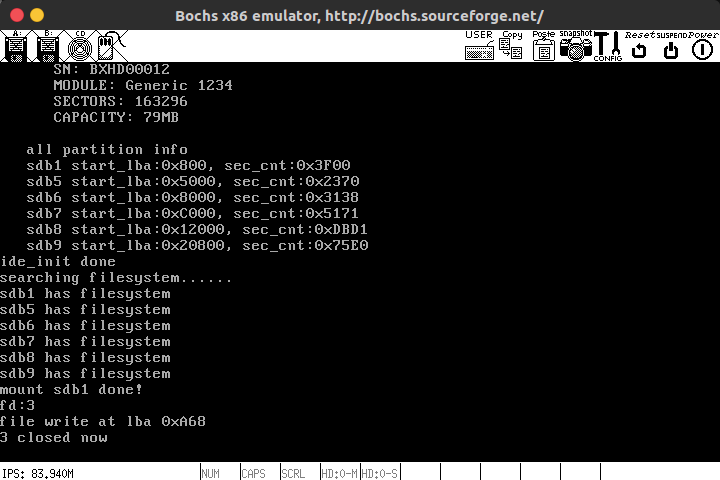
运行结果

图为bochs运行界面